
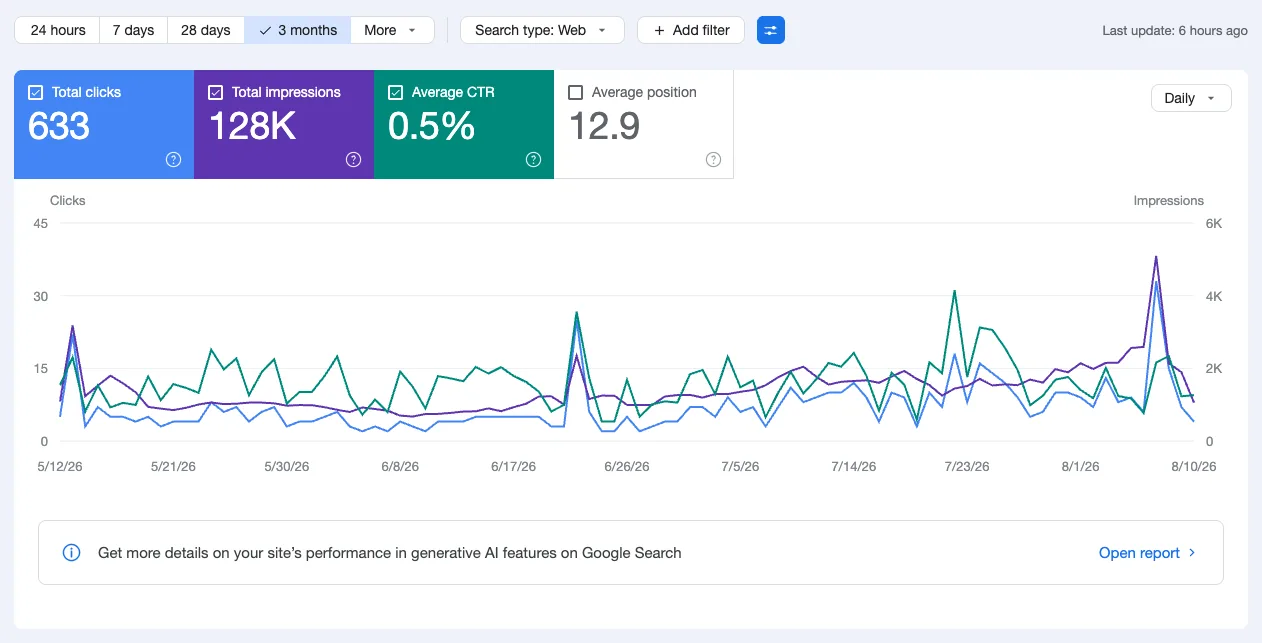
Our first inbound customers came from search. Not outreach, not ads.
Priya N.
Early-stage startup
See your Google & AI rankings, speed and content gaps before your competitors do.
Illustration of a sample scan: a site missing from the Google results, three AI assistants recommending other sites, and an example of the missed traffic priced in dollars. The figures and domains are made up.
Your real position on the searches your buyers make, what ChatGPT, Claude and Gemini say when asked, your load speed, and the headings, descriptions and schema missing across your pages.
Every problem comes back with what it's costing you and what to change, ranked worst first — so the work starts with the thing that pays back fastest.
The searches you're missing, priced at what those clicks cost in Google Ads — so you can see what closing the gap is worth before you spend anything on it.
Our first inbound customers came from search. Not outreach, not ads.
Priya N.
Early-stage startup
I assumed engineering was word-of-mouth only. I assumed wrong.
Henrik S.
Engineering firm
Someone asked ChatGPT for a clinic near them. It named us. That’s the whole ballgame now.
Dr. Omar H.
Local medical clinic
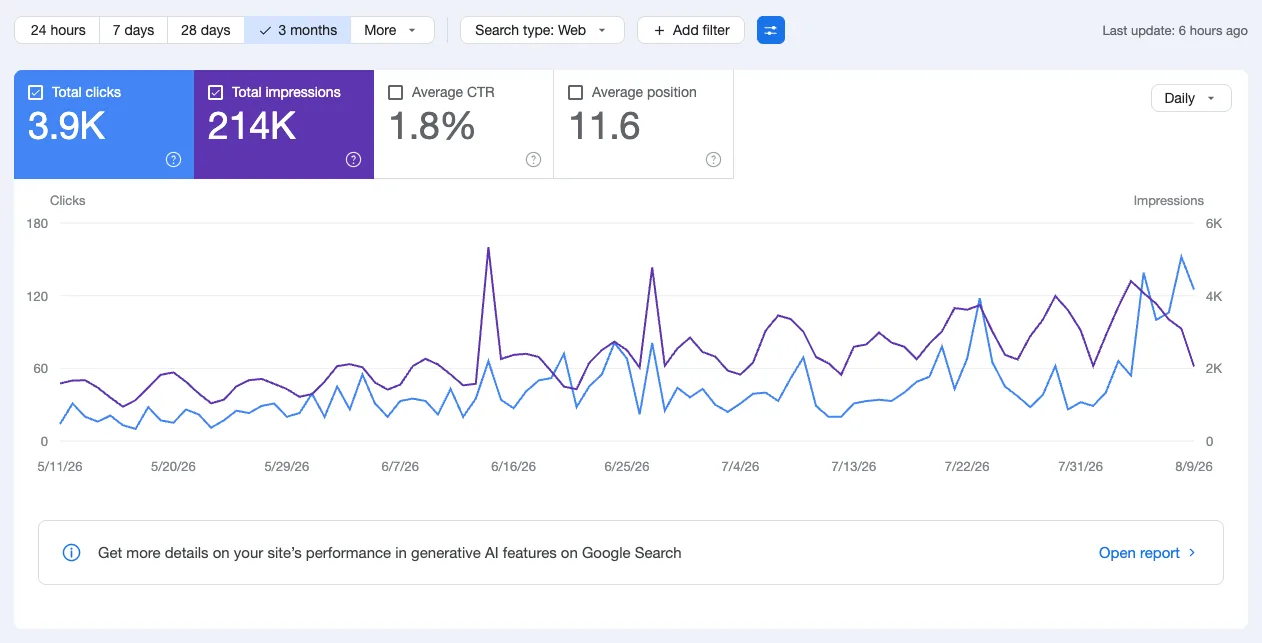
We lived off referrals for nine years. First cold inquiry felt strange. Now half our pipeline comes that way.
Greg V.
Regional B2B
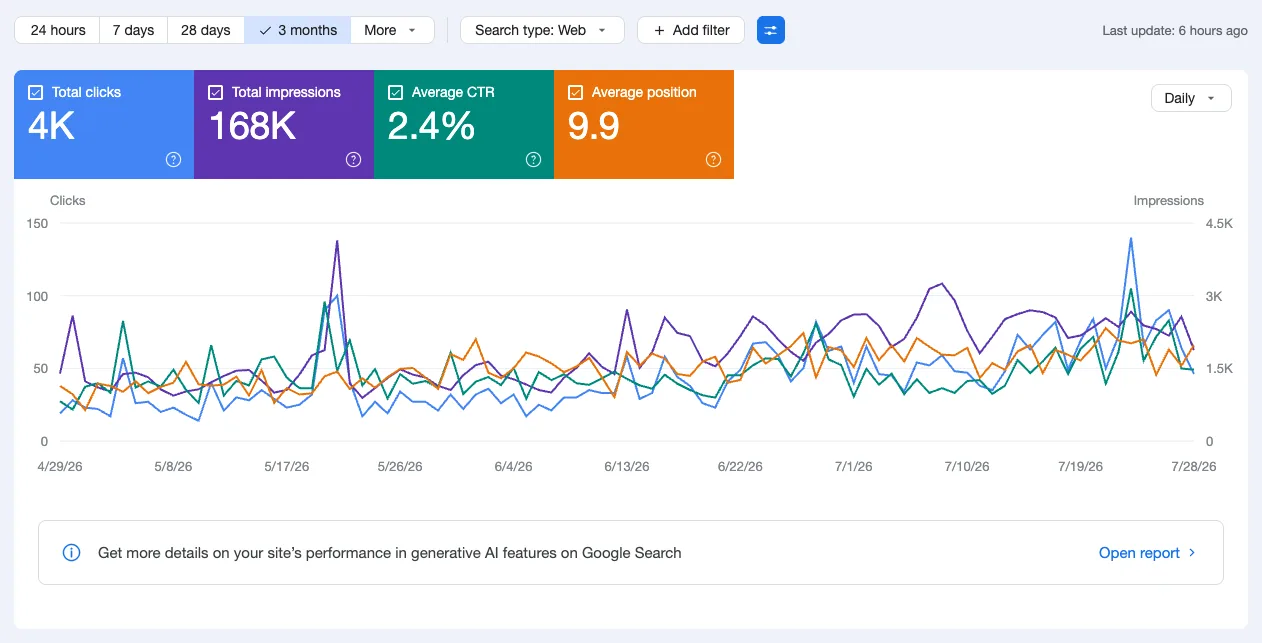
Every competitor in town was above me on Google. Flipped that before spring.
Danny R.
Landscaping
Three of my five locations were invisible on Google. Not anymore.
Tony M.
Multi-location automotive
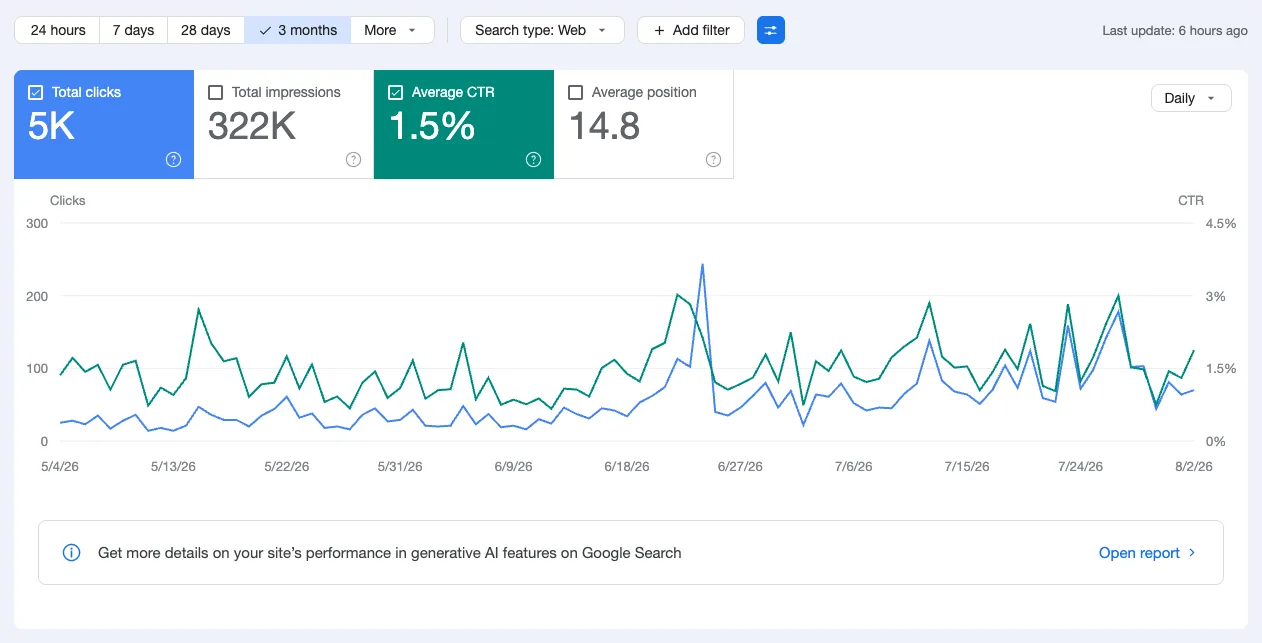
Turns out our content had ranking problems because it was written for not what people search. Bytown fixed that and we get way more visibility.
Simone L.
Content publisher / ecommerce
I don’t understand any of this and I don’t have to. That’s the point.
Felix B.
Independent consultant
Most owners I talk to don't have a 2026 AI SEO plan. They have no plan, run an old playbook, and never check whether AI or Google recommends them.
So we built this free AI SEO tool to help. Put in your website, and it takes about 60 seconds to answer. You don't have to talk to anyone to get the result. If it comes back saying you're in good shape, that's great news for you.

Tomas Kolafa
Founder, Bytown
Half of my catalog products had never been found by anyone.
Rahul D.
Ecommerce store
People ask AI what tool to use now. We show up in those answers. Didn’t know that was something you could influence.
Jenna F.
SaaS
Clients used to find us through one magazine feature from 2019. That well ran dry years ago. Now they just find us.
Yuki T.
Architecture studio
Big brands owned every search in our category. We finally got a seat at the table.
Caleb O.
Marketplace
We used to pay $4K a month for long audits. Now I get results and skip the deck. No brainer ROI.
Marguerite A.
National furniture retailer
Parents research schools for months before they ever call. We were absent for all of it. Now we’re in that research.
Sister Anne-Marie C.
Private school
People who need us didn’t know we existed. That was the real problem. Not funding, not awareness campaigns — just being findable.
Dana W.
Statewide nonprofit
An SEO audit is a check of everything that decides whether search engines can find your site, understand it, and rank it. A good one covers four things: where you actually rank for the searches your buyers type, how fast your pages load, what’s missing from your page code, and whether AI assistants mention you.
That last one is new. Most audits still stop at Google, which was fine when Google was the only place a buyer looked. A growing share of the questions people used to type into a search box now get typed into ChatGPT instead, and an audit that ignores that is measuring half the market.
An audit is also not the same thing as a report. A report tells you what happened last month. An audit tells you what is broken and what it is costing you.
Once a quarter for most small businesses, plus any time something structural changes — a redesign, a platform move, a batch of new pages, or a traffic drop you can’t explain. Monthly is overkill unless you publish constantly. Once a year is too slow to catch a problem while it’s still cheap.
SEO problems get more expensive the longer they sit. A missing meta description costs you nothing on the day it happens. Six months later it has been costing you clicks every day on every page it’s missing from, and the competitor who filled that gap now has six months of ranking history you have to overtake.
Re-scanning costs nothing, so the practical answer is simpler: run one whenever you’ve changed something and want to know whether it broke anything.
Answer engine optimization (AEO) is the work of getting your business named inside the answer an AI assistant writes, rather than ranked in a list of blue links. Generative engine optimization (GEO) is the same idea under a different name. Nobody has settled which term wins; they describe the same job.
Two names exist because two groups coined them at roughly the same time and neither backed down. If a tool sells you one and a consultant sells you the other, they are selling the same work.
And that work is mostly being described — clearly, and in more than one place — on pages these models read: your own site, but also directories, review sites, industry publications, anywhere that says what you do. The models are not reading your meta tags. They are reading sentences about you.
Room. A Google results page has ten positions, so ten businesses win something. An AI assistant writes one answer and names a handful of businesses inside it. The signals that get you into that answer overlap heavily with the ones that rank you on Google — there is simply far less space to land in.
What carries over: being a clear, well-described business; having real content that answers real questions; being mentioned on sites other than your own.
What doesn’t: most of the technical tricks. There is no meta description to write for ChatGPT, no title tag to tune, no position to climb one place at a time. You are either in the answer or you are not.
Usually one of four things: the page isn’t indexed at all, it is indexed but ranks below the top 50, it ranks for words nobody actually searches, or a competitor simply outranks you. All four look identical from where you’re sitting, and the fix for each one is completely different.
The most common is the third. You rank — just for phrasings your buyers don’t use. Searching for your own business name and finding yourself proves nothing, because you are the only person who searches that way.
The scan separates them. A keyword that appears nowhere in Google’s first 50 results comes back as “Not in Google’s top 50”. A keyword where you sit at position 23 comes back as position 23. The first is an indexing or content problem, the second is a ranking problem, and they don’t get fixed the same way.
Ask them the question your buyer would ask — “best [what you do] in [your city]” — without naming your business, and see who gets named instead. Do it in a fresh chat with no history, or you will get an answer shaped by everything you have already told it about yourself.
That last part catches most people. Asking an assistant you have used all week whether it recommends you is not a test. It already knows who you are.
The scan does this against three assistants at once, using a buyer question written from your own homepage, and shows you each answer in full.
One thing worth knowing before you read those answers: only one of the three searches the live web when it replies — Gemini, which runs with Google Search attached. The other two, ChatGPT and Claude, answer from what they learned in training. So a site published this month can be invisible to two of the three no matter what you change on it, and the fix for those two isn’t on your website at all.
Mostly by what it read during training, not by looking you up when you ask. Unless it runs a web search for that specific question, it is recalling what it has already read about your industry. So being described on sites the model has read matters more than anything on your own website.
This is the part that surprises owners. You can rewrite every page on your site and change nothing about what ChatGPT says this month, because your site is one document among billions and it may be a long time before the new version is read at all.
What does move it: being named in places that get read a lot. Industry roundups. Review sites. Local directories with real listings rather than scraped ones. Press. Threads where somebody asked for a recommendation and got yours. The uncomfortable version of that is that your reputation away from your website now shapes your visibility more than your website does.
Five things. It finds up to 30 of your pages and audits up to 20 of them. It checks where you rank on Google for eight keywords, to a depth of 50 results. It measures mobile and desktop speed through Google PageSpeed Insights. It asks three AI assistants about you. Then it prices the gap.
The eight keywords are not guessed. They start as categories read off your homepage, get expanded into real search terms by Google’s own Keyword Planner, and are then cut down to the eight that best describe what you actually sell.
What it does not do, so nothing surprises you: no backlink analysis, no rank tracking over time, no competitor teardown beyond a traffic comparison, and one buyer question per assistant rather than a panel of them. It is a diagnostic, not a subscription.
Four rows make the number. The biggest is measured exactly: for each keyword, monthly searches, multiplied by the share of clicks you are missing by ranking where you rank instead of where you could, multiplied by what one click costs in Google Ads. Speed, AI visibility and page gaps add three smaller rows, each labelled an estimate.
The details, so you can check the arithmetic yourself. “Where you could rank” is not position one for everything — it is position 3 on a low-competition keyword, 5 on medium and 8 on high, because promising you the top spot on a term twenty funded companies are fighting over would be a lie. The click-through rate for each position is our own table rather than a vendor’s, and here it is: 28% of clicks at position 1, 15% at 2, 10% at 3, tapering to 1.5% at position 10 and 0.8% anywhere on page two. We rounded those down deliberately — a curve that flatters position one flatters every dollar figure built on top of it. What one click costs is the part most tools get wrong, so here is exactly what we do. Google Ads Keyword Planner reports a top-of-page bid range for every keyword — what you would have to bid to sit at the top of the page. That is not what a click costs, and on competitive terms the two are nowhere near each other: Keyword Planner puts “google ads” between $29 and $469 a click, while the three accounts we run ourselves measure under $2. So we price each click at the measured average for your industry — LocaliQ and WordStream’s 2026 benchmarks, the same fifteen categories we publish on our Google Ads cost calculator, so you can check us against our own page — and use Google’s bid range only to say which of your keywords are the expensive ones, capped at half to double that industry average. Canadian businesses are priced lower, by the Canada-to-US ratio our own Keyword Planner pull measures across 21 industries. Every dollar on this page is US dollars — Keyword Planner bills our account in Canadian dollars, so we convert once at 1.3896 (Bank of Canada, September 1, 2026).
The three estimated rows are deliberately small and built only from numbers the scan measured: slow pages are priced at 7% per second of load time past the 2-second bar, applied to what your keywords are worth at the better of where you rank today and where you could rank, AI visibility at the 5% of category searches we assume assistants now answer, and page gaps at a 2% click-through haircut on the pages missing basics. Those coefficients are our own conservative choices, not anyone’s study.
Two honest caveats. This is what that traffic would cost you to buy, not profit you are losing — what it is really worth to you depends on your margins and on how well your site converts. And the estimated rows are exactly that — directional. The search rows are the part to check us on, and every number they use is shown on the page.
Free, with no account and no credit card. Your score, your speed, your Google positions, all three AI answers and the dollar figure are visible without giving us anything. Only the full ranked list of fixes asks for an email, and that is the whole trade.
We only read what is already public — the pages anyone can open in a browser. We store the scan so the report can be reloaded, and so we can spot someone hammering the service.
One thing to know before you share it: your result has its own link, and while that link is long and unguessable, it is not password-protected. Anyone you send it to can open it. Treat it like a shared document rather than a private one. The full detail is in our Privacy Policy.
Pages, headings, alt text and schema — this is what Google and the AI assistants actually read.
Measured the way Google measures it — a full page load over a throttled mobile connection.
Loading your site on a throttled mobile connection...
This is the slowest check — it runs a full page load.
Mobile load time · speed score – · desktop: –
Running the exact searches your buyers make — and finding where your business actually shows up.
Your buyers ask ChatGPT, Claude and Gemini before they ever open Google. Here's what each one really said.
Each bubble is a share of the clicks we measured across these searches — you vs. the sites that outrank you.
estimated revenue going to competitors
Also costing you — not priced above